Research
Updated October 30, 2026
AutoRouter, the Mac app for Codex and Claude Code, measures what AI models cost and how well they do on real tasks, and publishes every run. Each finding on this page is one sentence you can quote as written, with its date, its chart and a link to a method that was published before the first run.
The findings, charts and data are free to reuse under CC BY 4.0. Credit AutoRouter and link to this page, and every chart has embed code that does both for you.
Claude Code task costs
On October 28, 2026, AutoRouter ran five everyday Claude Code tasks three times each on Claude Opus 5.5, Claude Sonnet 5.5 and Claude Haiku 5.5 in the same Python repository and recorded the tokens and list-price cost of every run. The write-up is what common Claude Code tasks cost, measured on each model, the method is in method.md, and the Claude Code cost calculator turns the results into a monthly estimate. For any other workload, the Claude API cost calculator prices it on every current Claude model with and without prompt caching.
Cost of an average Claude Code task
An average Claude Code task cost $0.110 on Claude Opus 5.5, $0.049 on Claude Sonnet 5.5 and $0.0044 on Claude Haiku 5.5 at Anthropic's list prices, in 45 runs of five everyday tasks that AutoRouter measured on October 28, 2026.
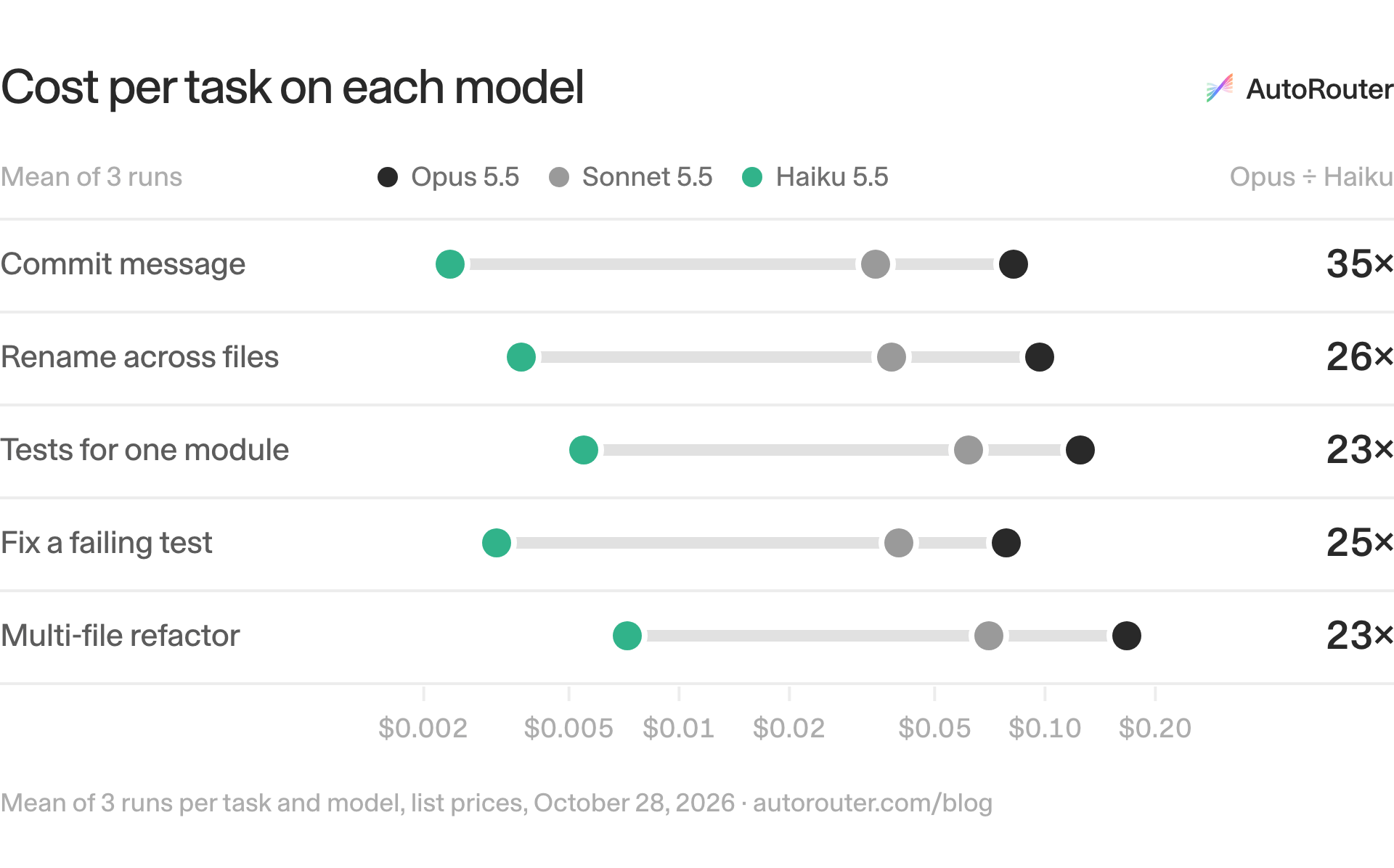
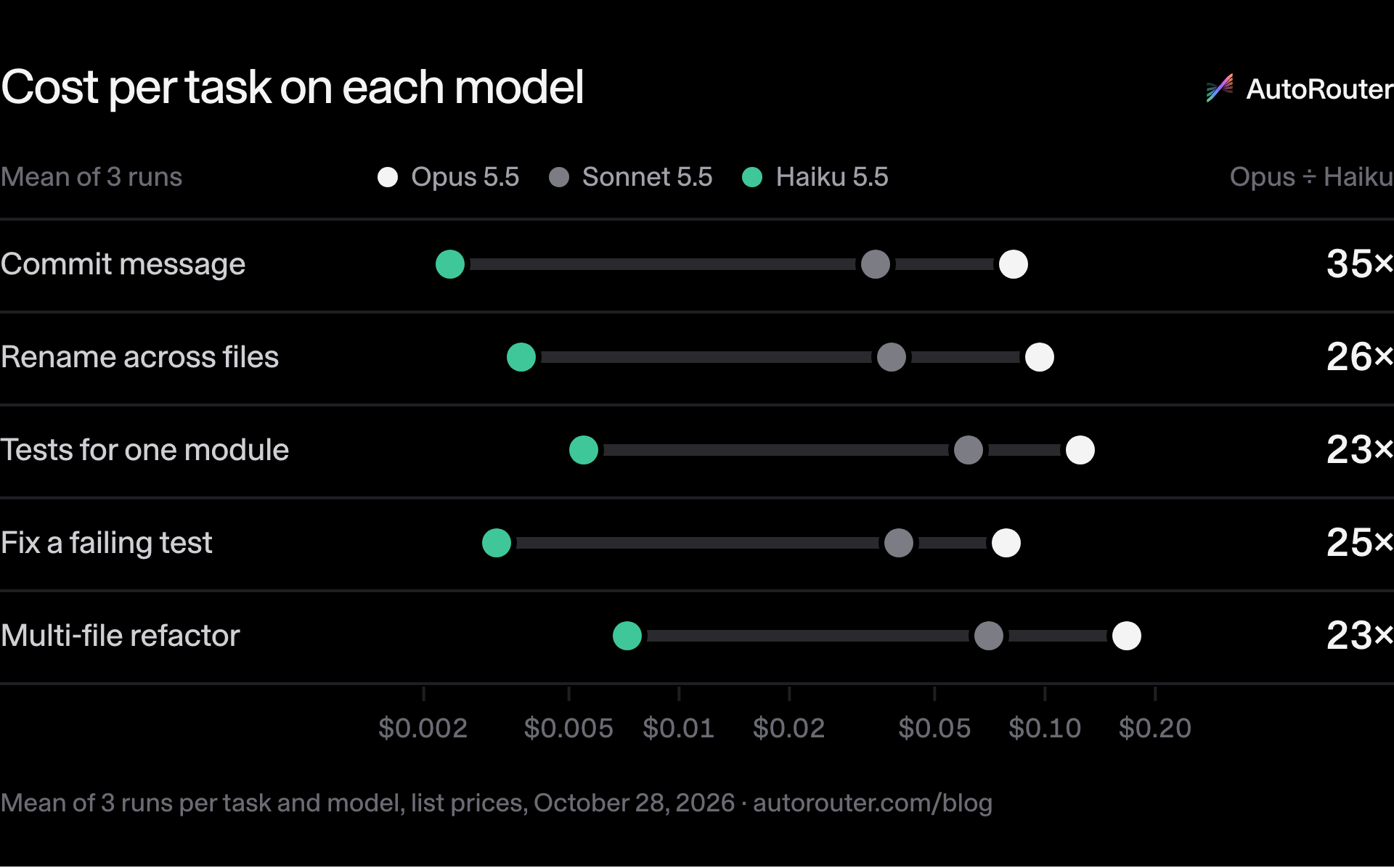
An average Claude Code task cost $0.110 on Claude Opus 5.5, $0.049 on Claude Sonnet 5.5 and $0.0044 on Claude Haiku 5.5 at Anthropic's list prices, in 45 runs of five everyday tasks that AutoRouter measured on October 28, 2026. Source: AutoRouter, "Claude Code task costs by model, October 2026", https://autorouter.com/research#claude-code-cost-per-task
Claude Code tasks per dollar
One dollar bought about 9 everyday Claude Code tasks on Claude Opus 5.5, 20 on Claude Sonnet 5.5 and 228 on Claude Haiku 5.5 at Anthropic's list prices in October 2026, and every one of the 45 measured runs passed its automatic check.
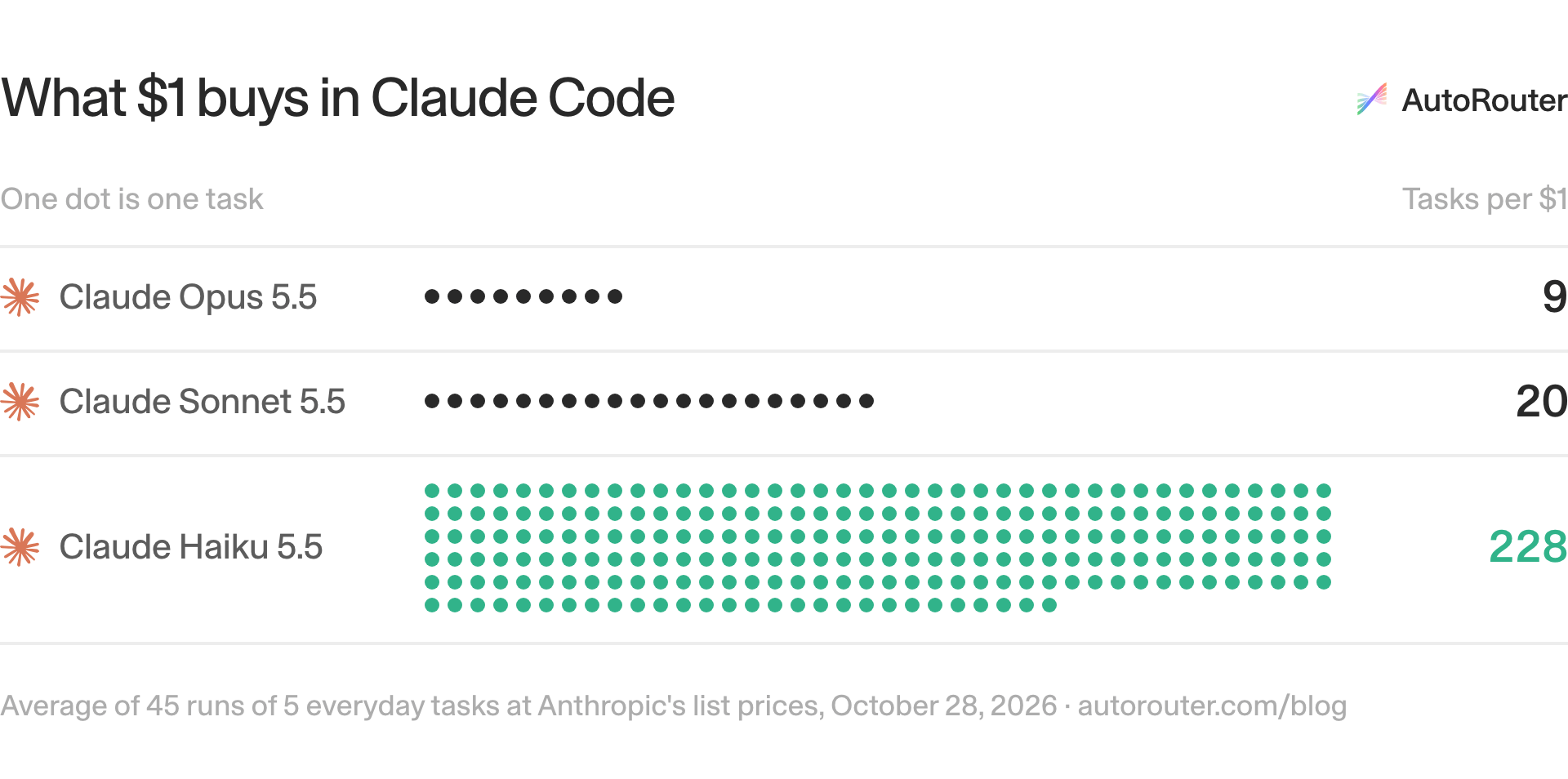
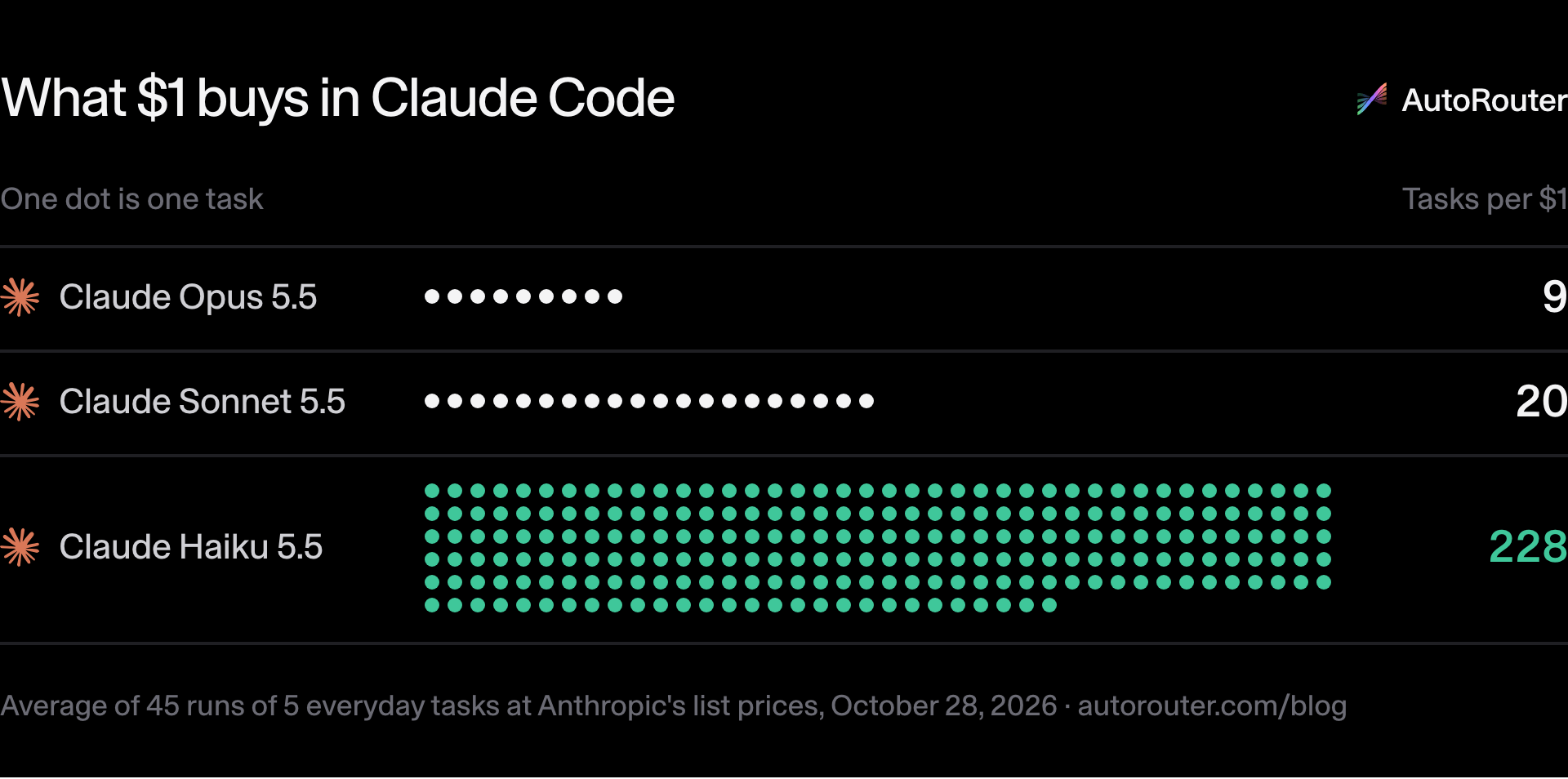
One dollar bought about 9 everyday Claude Code tasks on Claude Opus 5.5, 20 on Claude Sonnet 5.5 and 228 on Claude Haiku 5.5 at Anthropic's list prices in October 2026, and every one of the 45 measured runs passed its automatic check. Source: AutoRouter, "Claude Code task costs by model, October 2026", https://autorouter.com/research#claude-code-tasks-per-dollar
Price per token against cost per task
Claude Opus 5.5's input, output and cache-write prices are 40 times Claude Haiku 5.5's, but an everyday Claude Code task cost 25 times as much on Opus 5.5, because Haiku 5.5 took 1.5 times as many turns and wrote 1.7 times as much output to finish the same work.
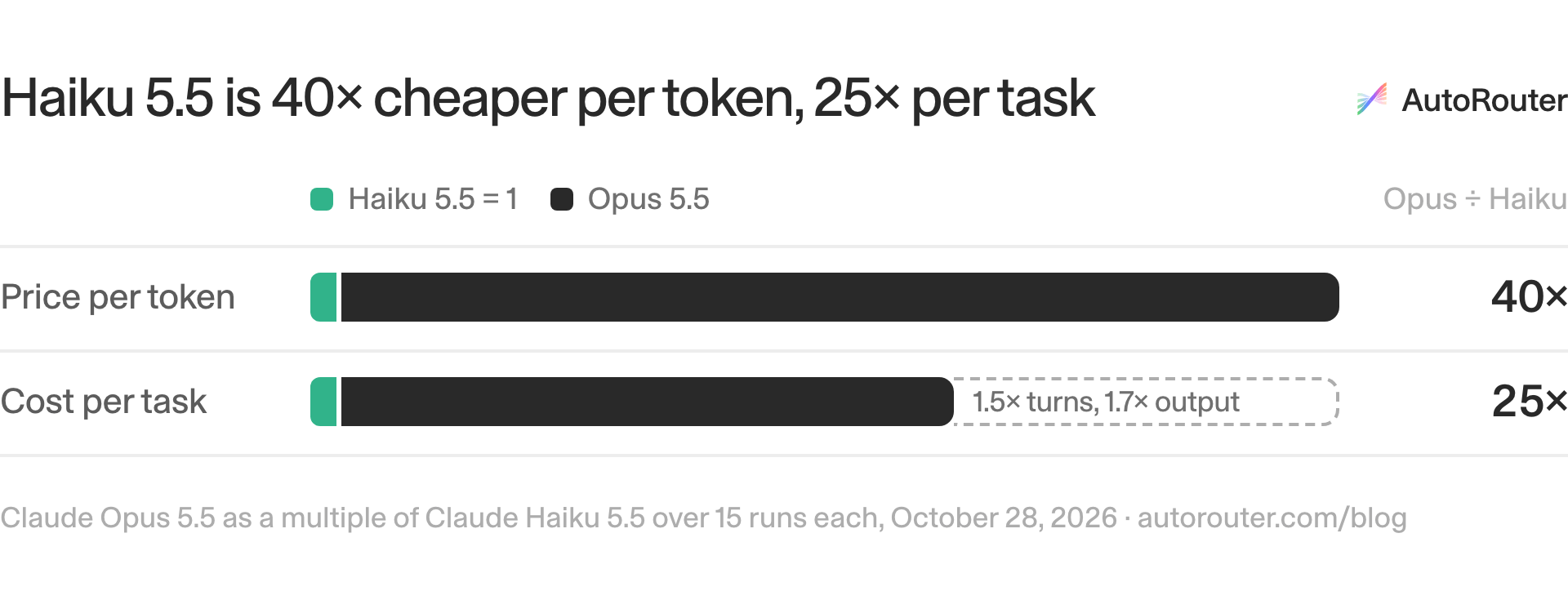
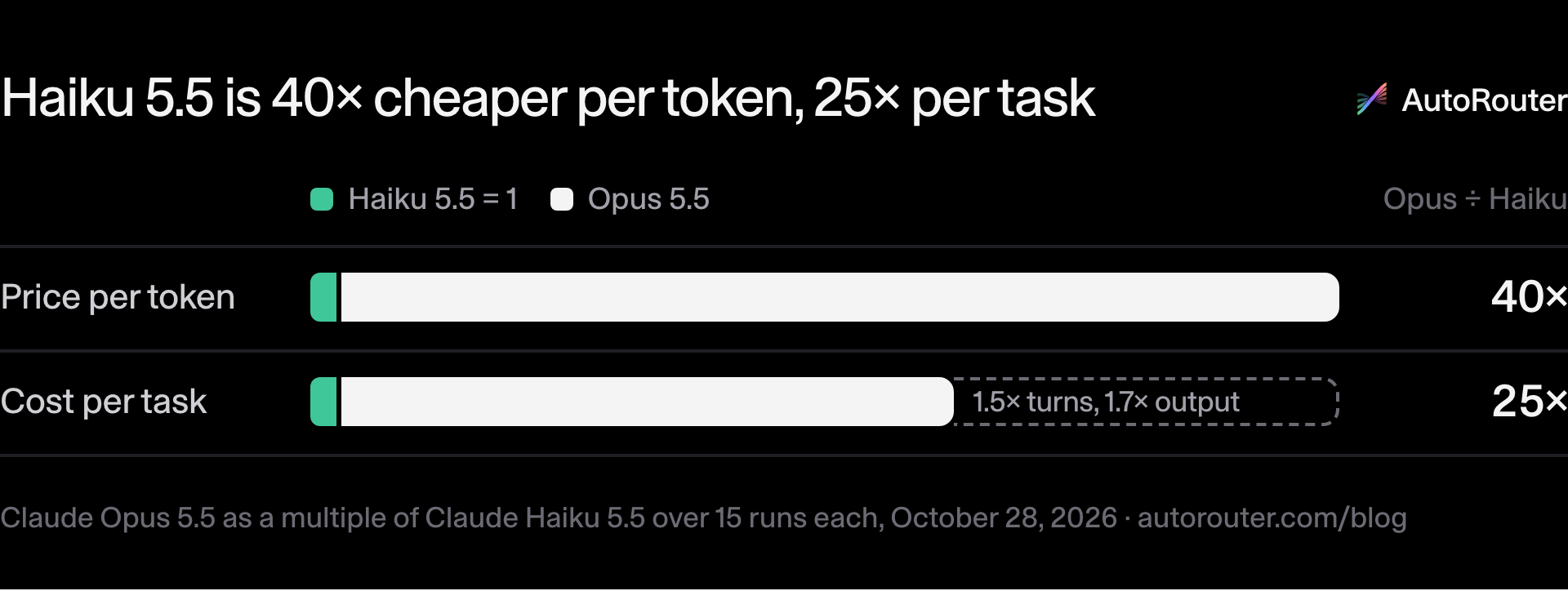
Claude Opus 5.5's input, output and cache-write prices are 40 times Claude Haiku 5.5's, but an everyday Claude Code task cost 25 times as much on Opus 5.5, because Haiku 5.5 took 1.5 times as many turns and wrote 1.7 times as much output to finish the same work. Source: AutoRouter, "Claude Code task costs by model, October 2026", https://autorouter.com/research#opus-haiku-price-gap
Prompt cache writes in Claude Code
Writing the prompt cache was the largest part of Claude Code's cost on every model AutoRouter measured in October 2026: 63% of the list-price bill on Claude Opus 5.5, 66% on Claude Sonnet 5.5 and 51% on Claude Haiku 5.5.
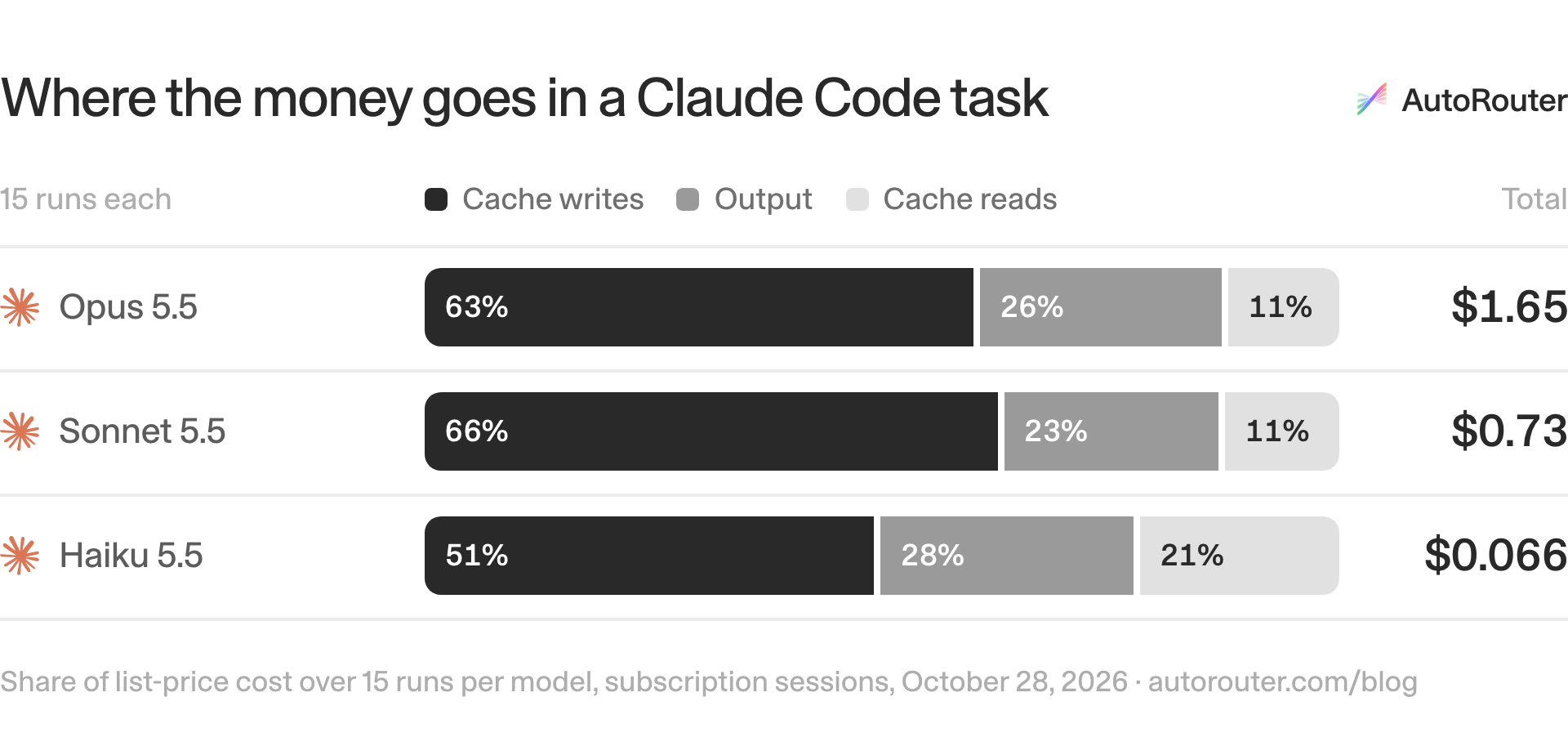
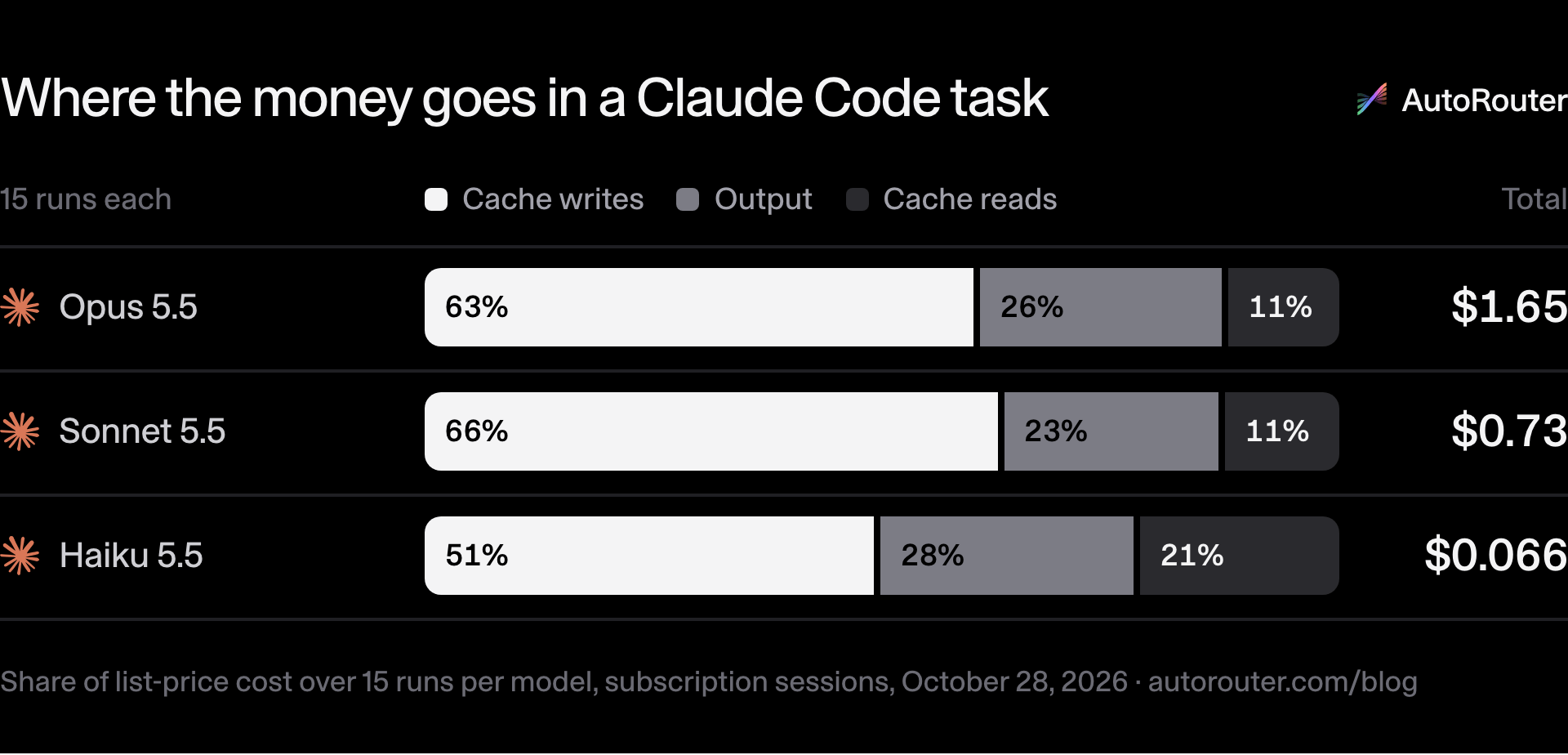
Writing the prompt cache was the largest part of Claude Code's cost on every model AutoRouter measured in October 2026: 63% of the list-price bill on Claude Opus 5.5, 66% on Claude Sonnet 5.5 and 51% on Claude Haiku 5.5. Source: AutoRouter, "Claude Code task costs by model, October 2026", https://autorouter.com/research#prompt-cache-share
Prompt cache length with an API key
With an API key, Claude Code writes the five-minute prompt cache at 1.25 times the input price instead of the one-hour cache at twice the input price, and the same 45 runs would have cost 24% less on Claude Opus 5.5, 25% less on Claude Sonnet 5.5 and 19% less on Claude Haiku 5.5.
With an API key, Claude Code writes the five-minute prompt cache at 1.25 times the input price instead of the one-hour cache at twice the input price, and the same 45 runs would have cost 24% less on Claude Opus 5.5, 25% less on Claude Sonnet 5.5 and 19% less on Claude Haiku 5.5. Source: AutoRouter, "Claude Code task costs by model, October 2026", https://autorouter.com/research#claude-code-api-key-cache
Deep research writers
On October 28 and 29, 2026, AutoRouter ran a trial of DeepResearch Bench on 20 of its tasks to find which step of a deep research task needs the strongest model. The trial used a substitute grader, so its scores compare within the study and don't belong on the benchmark's leaderboard. The write-up is which step of a deep research task needs the strongest model?, and the method is in method.md.
A cheaper model writing the report
Writing deep research reports from the same Claude Opus 5.5 research notes, Claude Sonnet 5.5 scored 0.88 points and Claude Haiku 5.5 scored 1.04 points below Opus 5.5 on DeepResearch Bench's RACE score, where Opus 5.5 averaged 53.15, in AutoRouter's 20-task trial in October 2026.
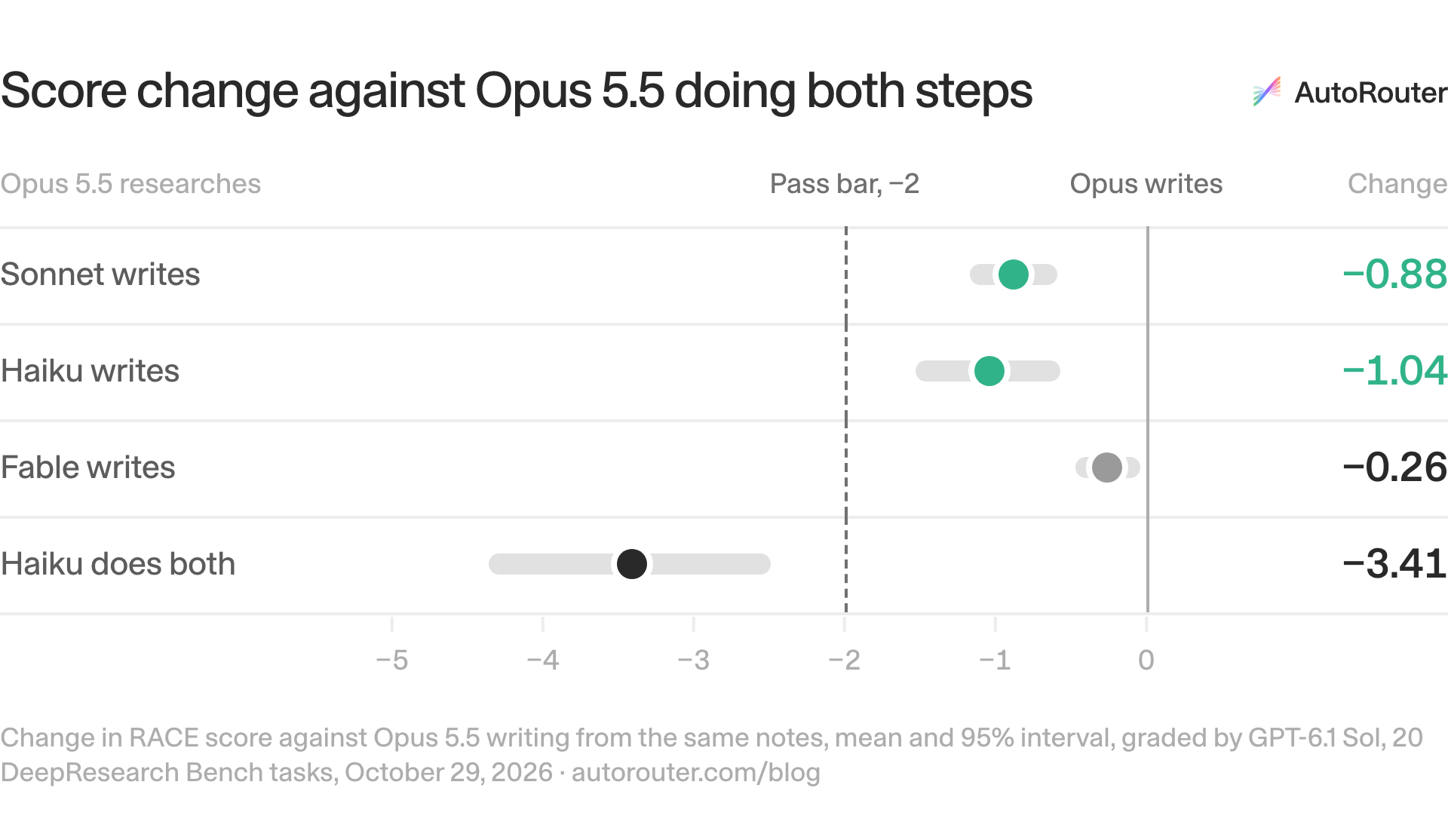
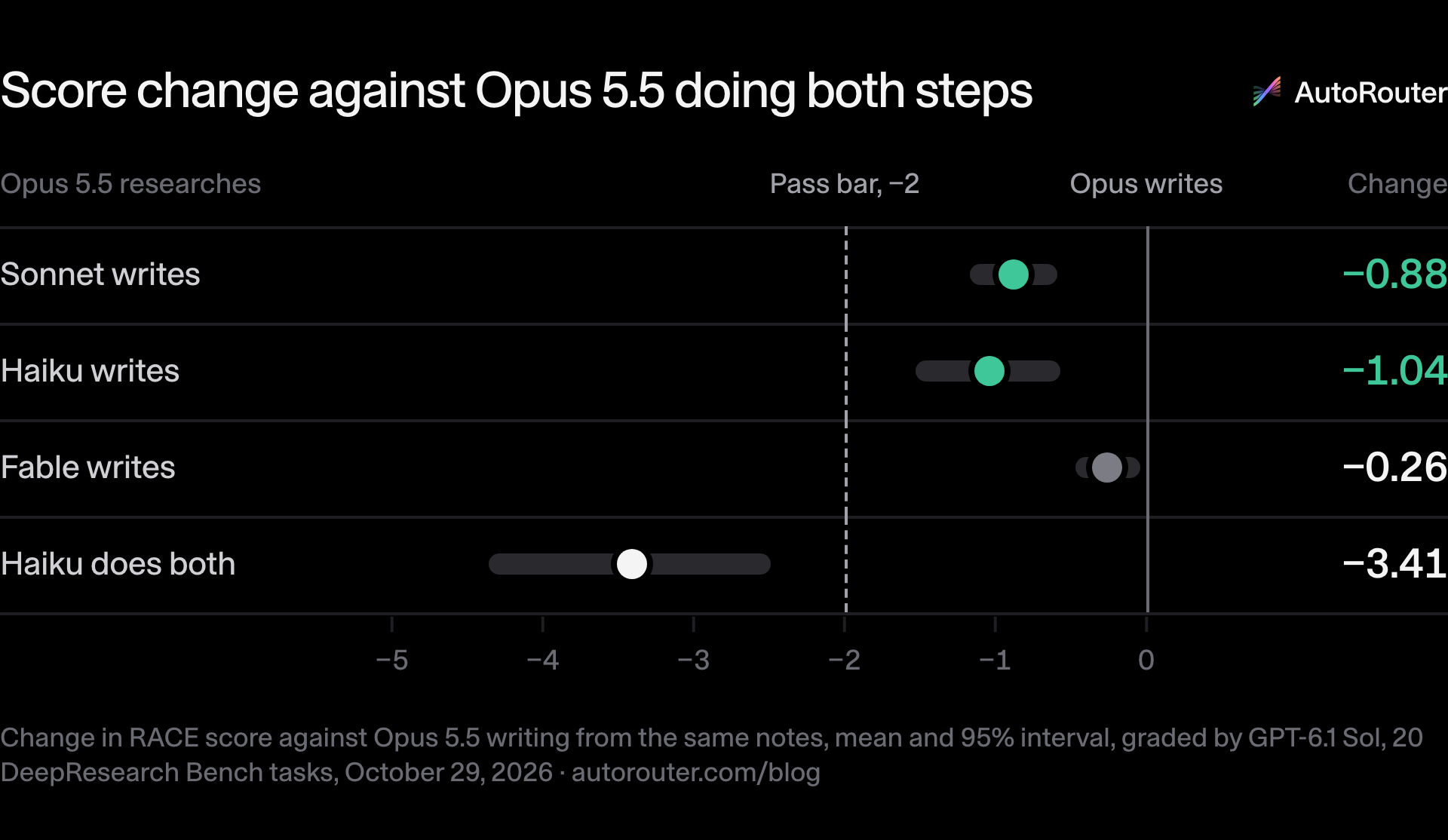
Writing deep research reports from the same Claude Opus 5.5 research notes, Claude Sonnet 5.5 scored 0.88 points and Claude Haiku 5.5 scored 1.04 points below Opus 5.5 on DeepResearch Bench's RACE score, where Opus 5.5 averaged 53.15, in AutoRouter's 20-task trial in October 2026. Source: AutoRouter, "Cheaper writers for deep research reports, October 2026", https://autorouter.com/research#cheaper-writer-score
The research step sets the ceiling
When Claude Haiku 5.5 did the web research as well as the writing, its deep research reports scored 3.41 points below Claude Opus 5.5's and fell below Opus 5.5 on 19 of 20 tasks, so the research step set the quality of the report.
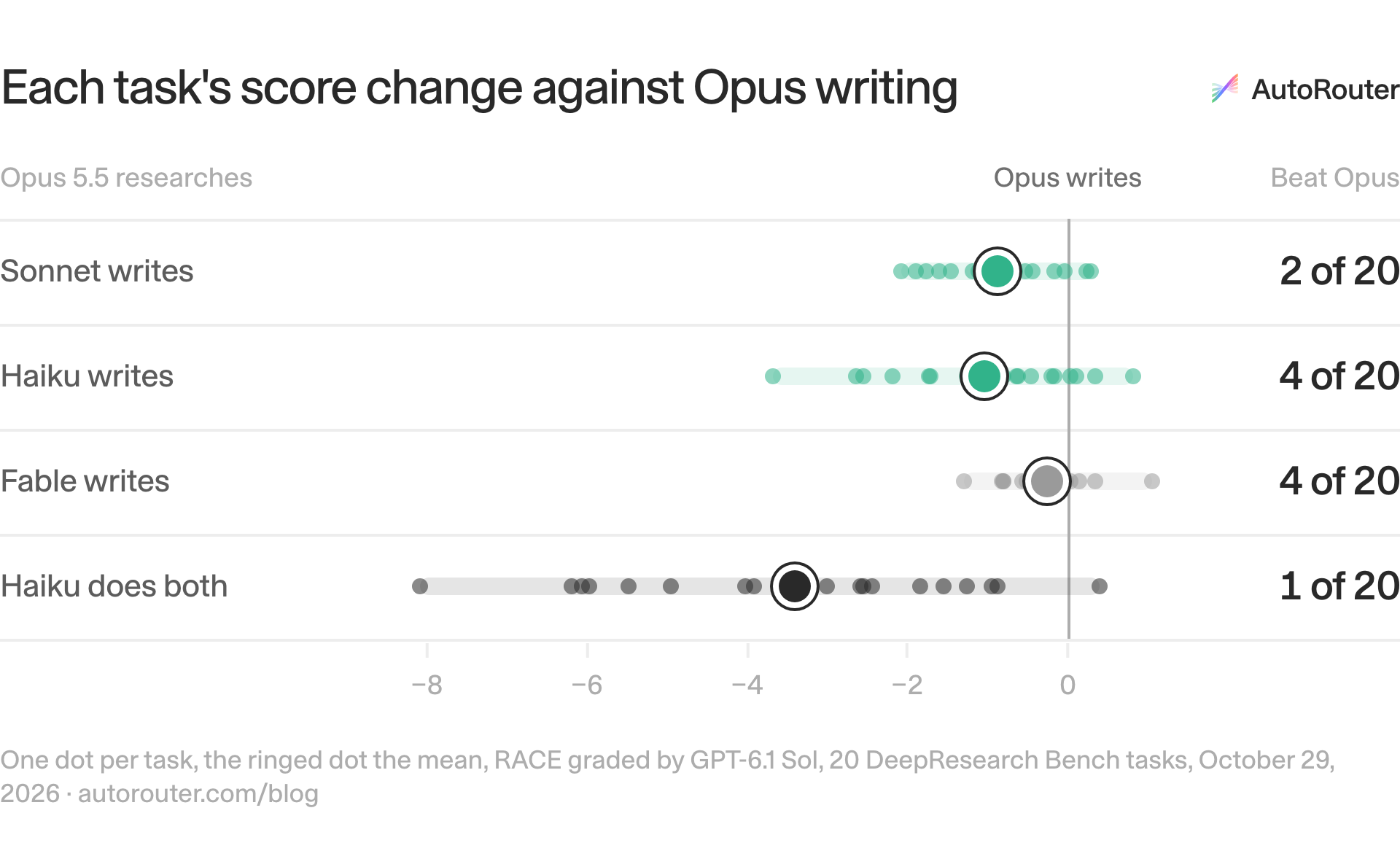
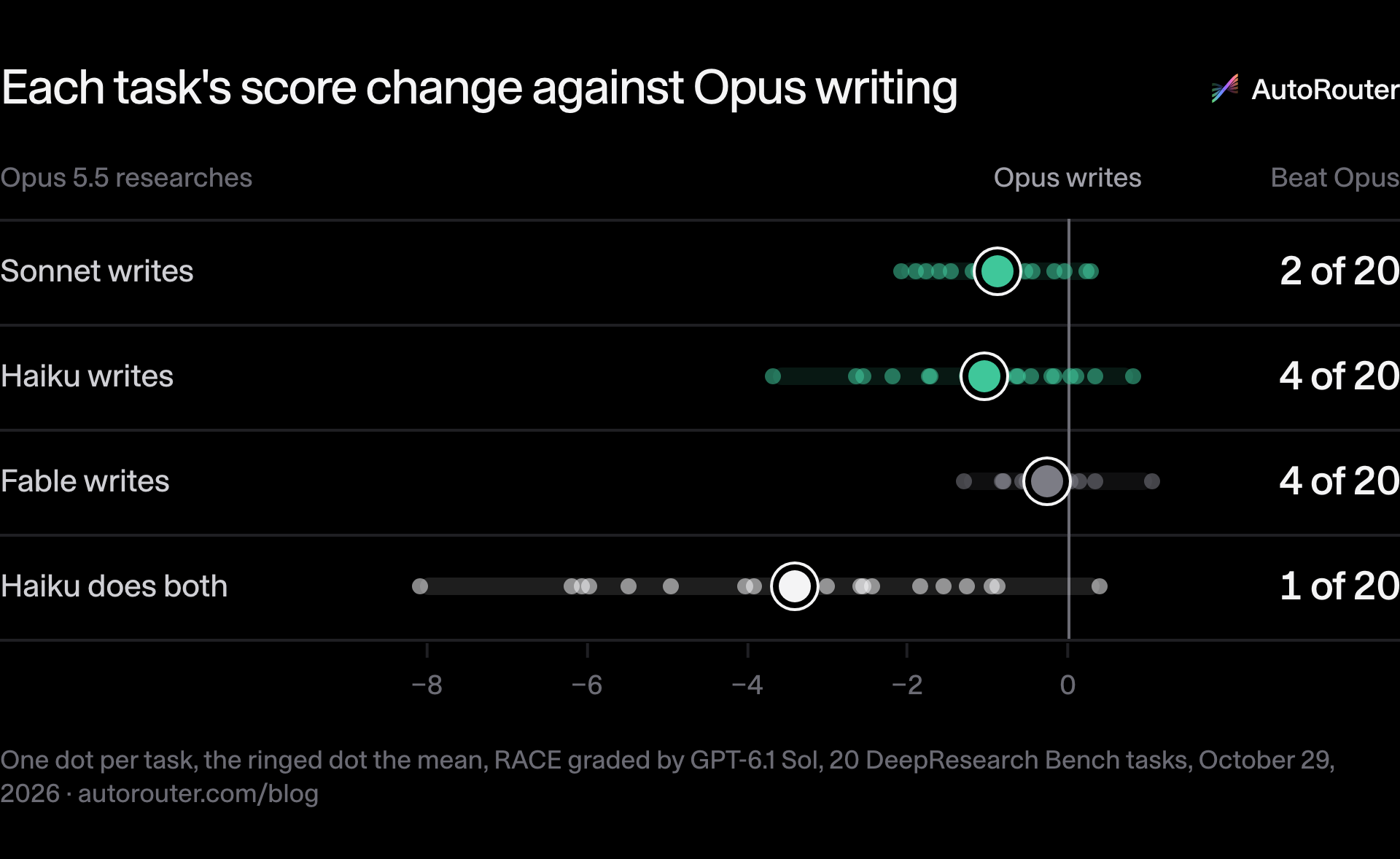
When Claude Haiku 5.5 did the web research as well as the writing, its deep research reports scored 3.41 points below Claude Opus 5.5's and fell below Opus 5.5 on 19 of 20 tasks, so the research step set the quality of the report. Source: AutoRouter, "Cheaper writers for deep research reports, October 2026", https://autorouter.com/research#research-step-quality
Where a deep research report's cost goes
Research was most of the cost of a deep research report: at list prices in October 2026, Claude Opus 5.5 spent $5.27 per report on research and $0.488 on writing, so the writing step was 8.5% of the $5.76 total.
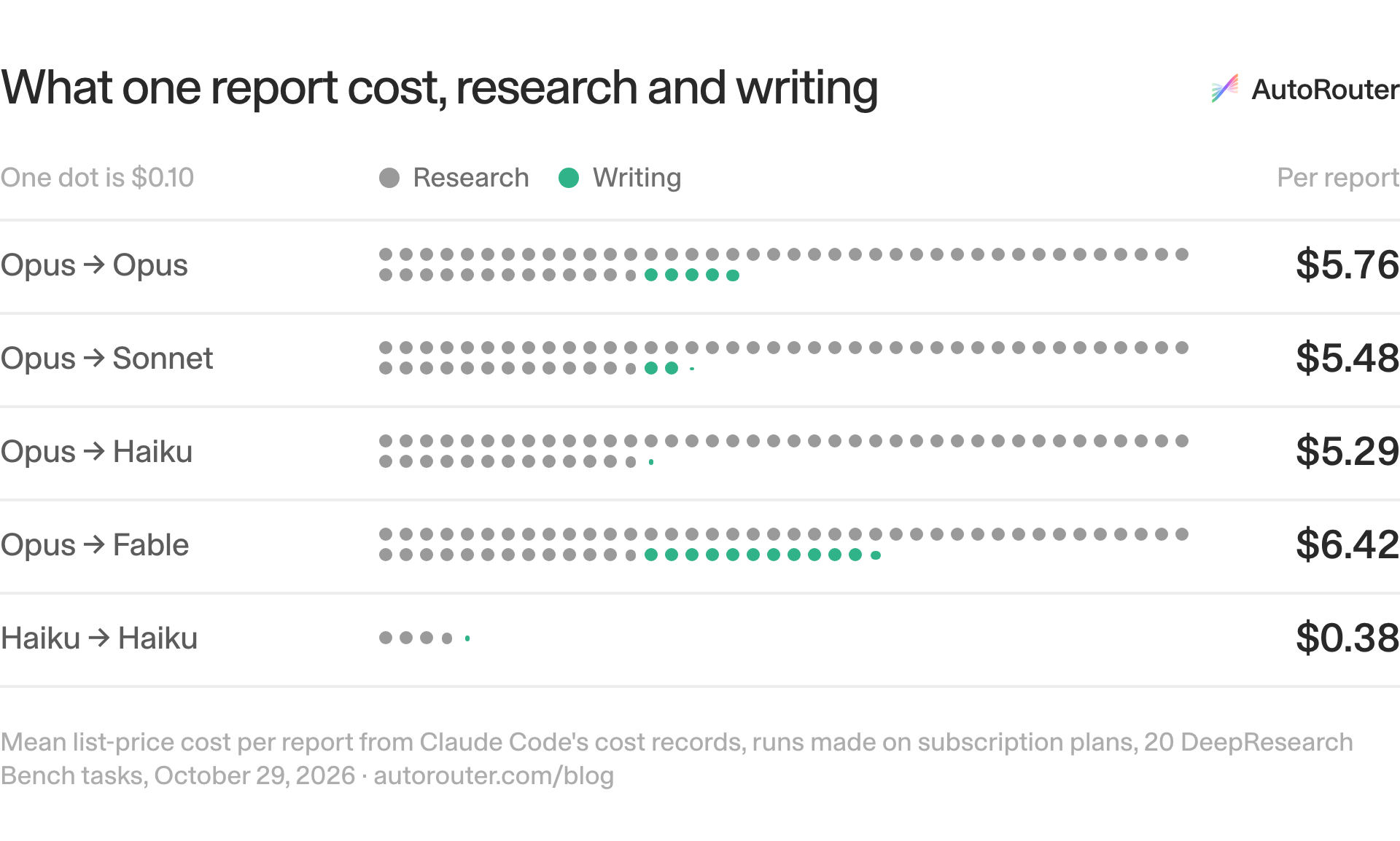
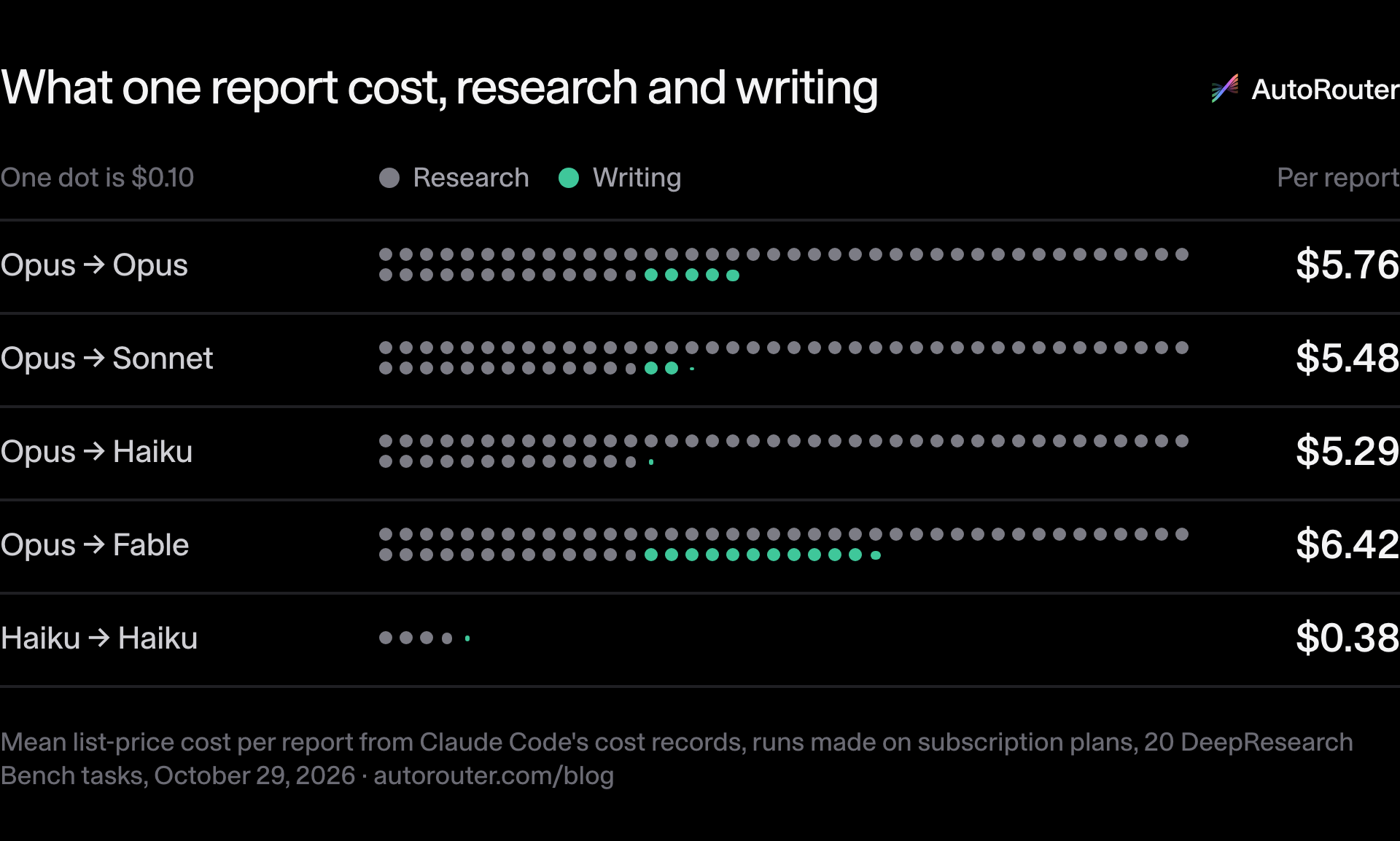
Research was most of the cost of a deep research report: at list prices in October 2026, Claude Opus 5.5 spent $5.27 per report on research and $0.488 on writing, so the writing step was 8.5% of the $5.76 total. Source: AutoRouter, "Cheaper writers for deep research reports, October 2026", https://autorouter.com/research#deep-research-cost-split
The most expensive writer
Claude Fable 5.1 cost 2.4 times as much as Claude Opus 5.5 to write a deep research report from the same notes, scored 0.26 points lower, and made 4.22 unsupported claims per 1,000 words against Opus 5.5's 2.78, in AutoRouter's October 2026 trial.
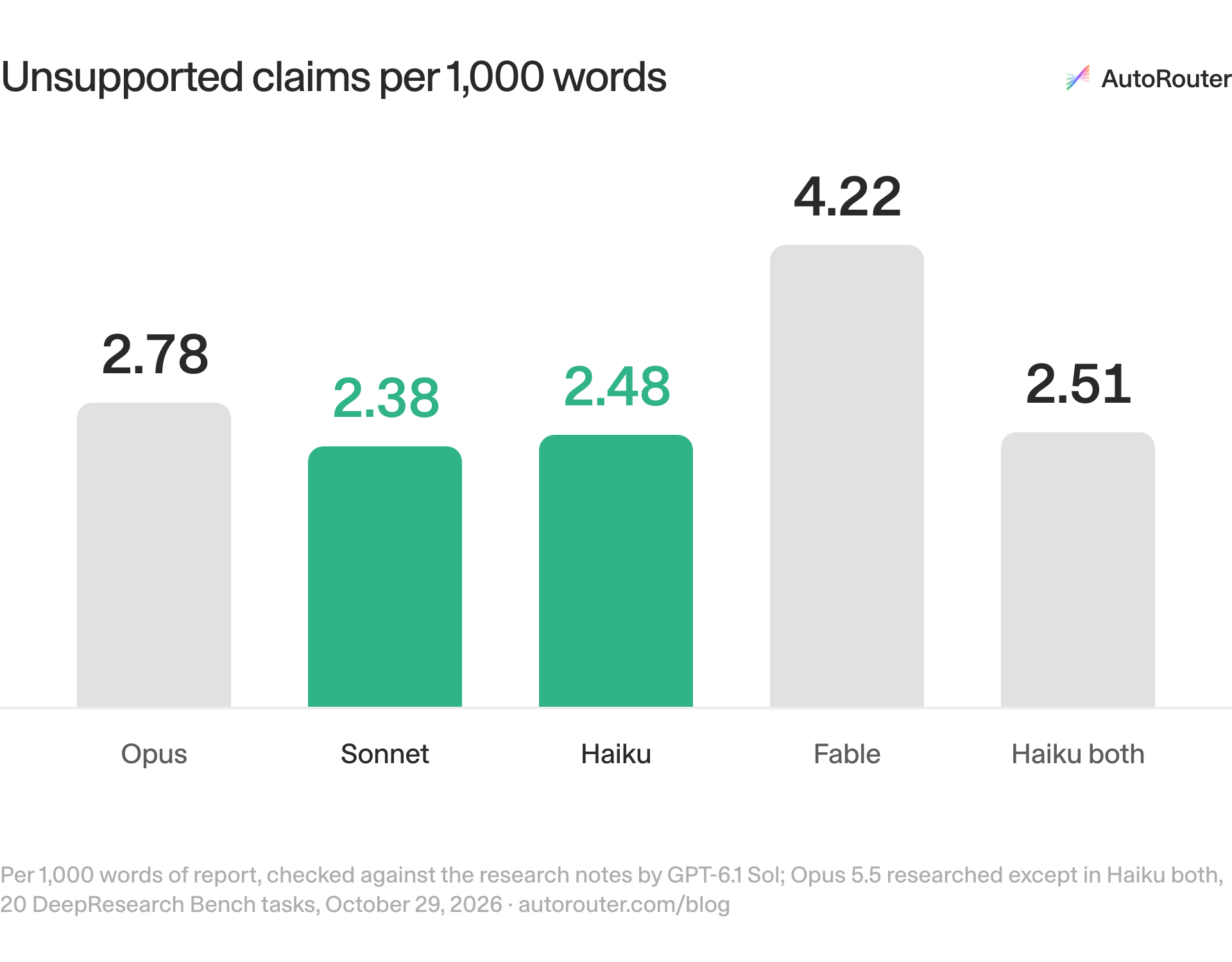
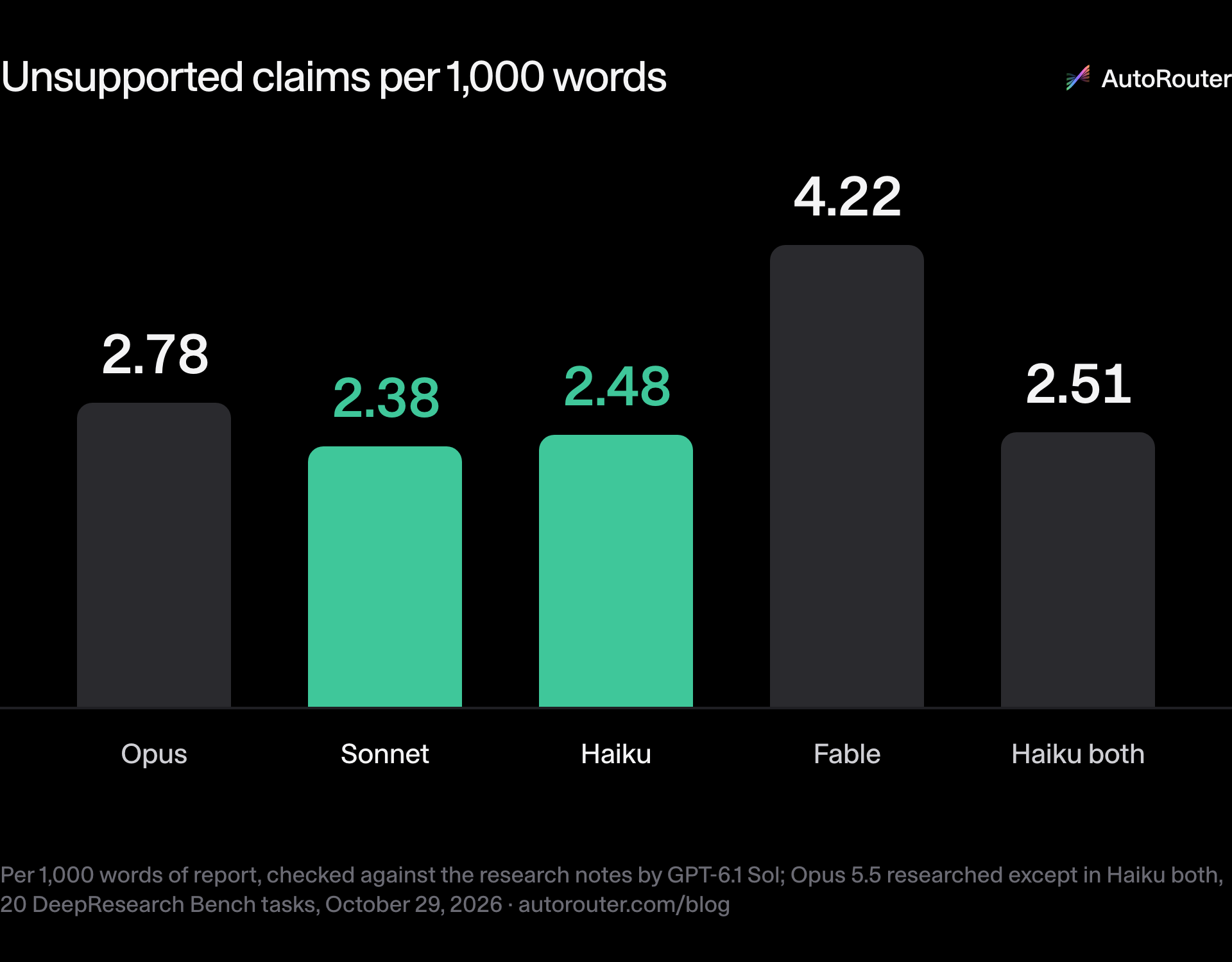
Claude Fable 5.1 cost 2.4 times as much as Claude Opus 5.5 to write a deep research report from the same notes, scored 0.26 points lower, and made 4.22 unsupported claims per 1,000 words against Opus 5.5's 2.78, in AutoRouter's October 2026 trial. Source: AutoRouter, "Cheaper writers for deep research reports, October 2026", https://autorouter.com/research#fable-writer
Embed a chart
Every chart on this page has embed code under it. Paste the code into
any page or post and the chart loads from autorouter.com with its source
line and a credit link, so the license is met as published. Each chart
also has a dark version at the same address with
-dark before .png.
The charts are drawn at 1,920 pixels wide and stay sharp at any column width. Their source line names the study and its date, so a cropped screenshot still carries its context.
Cite the data
Quote a finding with the button under it, which copies the sentence with its source and link. For a paper or a report, cite the study's post as the source and the data file as the dataset:
@misc{autorouter2026claudecodecosts,
  author       = {{AutoRouter}},
  title        = {What common Claude Code tasks cost, measured on each model},
  year         = {2026},
  month        = oct,
  publisher    = {Fractal Works, Inc.},
  howpublished = {\url{https://autorouter.com/blog/claude-code-task-costs-measured}},
  note         = {Dataset under CC BY 4.0: https://autorouter.com/studies/claude-code-task-costs/results.csv}
}

@misc{autorouter2026deepresearchwriters,
  author       = {{AutoRouter}},
  title        = {Which step of a deep research task needs the strongest model?},
  year         = {2026},
  month        = oct,
  publisher    = {Fractal Works, Inc.},
  howpublished = {\url{https://autorouter.com/blog/cheaper-model-deep-research-reports}},
  note         = {Dataset under CC BY 4.0: https://autorouter.com/studies/cheaper-model-deep-research-reports/results.jsonl}
}Datasets
| Study | Measured | Runs | Files |
|---|---|---|---|
| Claude Code task costs by model | October 28, 2026 | 45 | CSV, JSON Lines, method |
| Cheaper writers for deep research reports | October 28 and 29, 2026 | 140 | JSON Lines, method |
Both datasets are under CC BY 4.0 and can be fetched from any origin, so a notebook or a chart on another site can read them directly.
Questions
Can I use these numbers and charts in my own article?
Yes. The findings, charts and data are published under CC BY 4.0, so you can quote, embed and adapt them, including commercially, as long as you credit AutoRouter and link to this page or the study's post.
How were the studies run?
Each study's method was written down and published before its first counted run, and every run is in the published data. Costs are Claude Code's own list-price estimates for the tokens each run used; the runs used a Claude subscription, so no one paid these amounts per call.
Do these results measure AutoRouter's routing?
No. Every run used one fixed model, or a fixed pair for the deep research trial, with no router in between, so the studies measure the models themselves. AutoRouter doesn't publish routing benchmarks yet.
Who can I ask about the data?
Write to support@autorouter.com with questions about a study, a correction or a request for the raw files in another format.